
-
Sign Up! To view all forums and unlock additional cool features
Welcome to the #1 Dodge, Jeep and RAM Forum dedicated to FCA owners and enthusiasts. Register for an account, it's free and it's easy, so don't hesitate to join the SRT Forum today!
Forged Redeye Engine Failure :( Why????
- Thread starter 16GoManGoHC2
- Start date
OP

Thread Starter
#22
- Member ID
- #1139
- Messages
- 3,813
- Reactions
- 9,032
- Likes
- 252
- City
- Nanticoke
- State
- PA
- Country
- United States
- Vehicle
- 2016 Challenger He’ll Cat
Thread Starter
#22
Are you pointing out that it failed because of a lack of chamfer on bolt holes? I see no witness marks from the stud and washer on that bolt hole.
OP
Thread Starter
#24
- Member ID
- #1139
- Messages
- 3,813
- Reactions
- 9,032
- Likes
- 252
- City
- Nanticoke
- State
- PA
- Country
- United States
- Vehicle
- 2016 Challenger He’ll Cat
Thread Starter
#24
holes too big? Thermal expansion?
Expansion kind of sort of but not thermal.
The “parts” not up to the task are in the first picture, they did not fail but they did not do what was needed of them in this case, their part number was included for a hint. If there was 4 of them not 2 of them in at least caps 2 3 and 4 they would have worked. I’ve mentioned a few material types here, I’ll give another, 8740, it’s the culprit. What’s made from 8740 in the pictures?
-
 1
1
- Show All
- Member ID
- #11903
- Messages
- 8,742
- Reactions
- 7,676
- Likes
- 402
- City
- Orlando
- State
- FL
- Country
- United States
- Vehicle
- 2015 Dodge Challenger Hellcat

- Member ID
- #14500
- Messages
- 4,453
- Reactions
- 12,885
- Likes
- 302
- City
- Fremont
- State
- OH
- Country
- United States
- Vehicle
- 2022 Challenger Super Stock
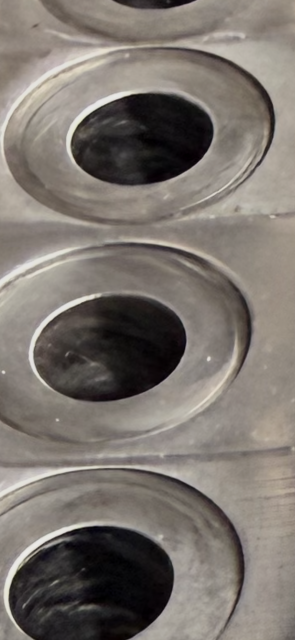
No, but why does the surface were the hardened stud washer sat have such a pronounced indentation from the washer? This is a 4140 material billet cap, they’re not soft. How did just torquing the nuts down on the washers do this? Aren’t the washers there to kind of spread the nuts load bearing surface out a bit more and provide a nice smooth hard surface for the nut to spin against and not dig into the cap?
Was the 8740 not heat treated correctly?
-
1
- Show All
OP
Thread Starter
#29
- Member ID
- #1139
- Messages
- 3,813
- Reactions
- 9,032
- Likes
- 252
- City
- Nanticoke
- State
- PA
- Country
- United States
- Vehicle
- 2016 Challenger He’ll Cat
Thread Starter
#29
8740 just did not have the tinsel strength to make enough clamp load so they started to stretch and start acting like springs. More of them, like 4 studs per cap would have spread the load across more fasteners or the use of larger diameter studs but unfortunately the use of both those methods in a standard BGE Gen 3 block probably then starts to weaken the block. The answer short of a better aftermarket 4 bolt block round gave been to use a better grade fastener, a tool steel stud. Just lime arp 8740 head studs, after 25 psi of boost I was lifting heads and getting combustion gas into the coolant, replaced the 8740 studs with a torque value of 110 ft lbs with 625 studs with a torque value of 150 ft lbs and no more combustion gas into the coolant! There tinsel strength exceeded the force of head up lift and kept the joint clamped. Unfortunately arp does not offer 625 main studs but they need too!! There are companies out there that offer them but their like 3-4x the cost of regular arp studs, no difference from how regular rods bolts are x price, arp 2000 2-3x price, and 625 5x price lol, you get what you pay for no doubt! I would prefer 625 over all other tool steels because it is not susceptible to hydrogen embrittlement like so many other tool steel fasteners are. You know you can ruin some, if not all non 625 tool steel studs by just touching them with bare hands? And cleaning them with brake cleaner can ruin them period??? Yes, they can! But not 625, it’s the greatest thing since sliced bread in a high tensile strength fastener that sees repetitive load unload cycles like main and rod bolts see, especially rod bolts.
I hope this has been entertaining and enlightening too many for the time I’ve spent on this form and the other, making a post on this very important topic of and stud, material differences, and why they are so important and what to look for in this assemblies and failures to know you have to do something better or not on rebuild.
I hope this has been entertaining and enlightening too many for the time I’ve spent on this form and the other, making a post on this very important topic of and stud, material differences, and why they are so important and what to look for in this assemblies and failures to know you have to do something better or not on rebuild.
-
1
- Show All

- Member ID
- #1043
- Messages
- 923
- Reactions
- 1,984
- Likes
- 132
- City
- Conway
- State
- AR
- Country
- United States
- Vehicle
- 2017 Dodge Hellcat Challenger
This surface is definitely part of the puzzle, it did not look like that when first assembled. They all looked like cap Number one. Why did it end up looking like that?
- Member ID
- #1043
- Messages
- 923
- Reactions
- 1,984
- Likes
- 132
- City
- Conway
- State
- AR
- Country
- United States
- Vehicle
- 2017 Dodge Hellcat Challenger
Agreed that 4140 is a very tough material, I machine parts out of it all the time. It takes a lot of pressure to indent the flat bolt surface.
Was the 8740 not heat treated correctly?
Was the 8740 not heat treated correctly?
-
1
- Show All

- Member ID
- #966
- Messages
- 4,599
- Reactions
- 9,534
- Likes
- 252
- City
- Buffalo
- State
- NY
- Country
- United States
- Vehicle
- 21 F150 Platinum Whippled
I assumed the caps were counterbored as well, squishing a washer into the cap is not a great idea.
Are you telling me those main studs aren’t rated for 1500-2000hp? My investigation lead me to believe that they were, but I don’t know anything from personal experience.
625 is also a hot topic with Steve Morris these days as it relates to their resistance to hydrogen induced delayed fracture. Since your studs were very much intact, I didn’t think about the material.
Are you telling me those main studs aren’t rated for 1500-2000hp? My investigation lead me to believe that they were, but I don’t know anything from personal experience.
625 is also a hot topic with Steve Morris these days as it relates to their resistance to hydrogen induced delayed fracture. Since your studs were very much intact, I didn’t think about the material.
OP
Thread Starter
#33
- Member ID
- #1139
- Messages
- 3,813
- Reactions
- 9,032
- Likes
- 252
- City
- Nanticoke
- State
- PA
- Country
- United States
- Vehicle
- 2016 Challenger He’ll Cat
Thread Starter
#33
I assumed the caps were counterbored as well, squishing a washer into the cap is not a great idea.
Are you telling me those main studs aren’t rated for 1500-2000hp? My investigation lead me to believe that they were, but I don’t know anything from personal experience.
625 is also a hot topic with Steve Morris these days as it relates to their resistance to hydrogen induced delayed fracture. Since your studs were very much intact, I didn’t think about the material.
Are you telling me those main studs aren’t rated for 1500-2000hp? My investigation lead me to believe that they were, but I don’t know anything from personal experience.
625 is also a hot topic with Steve Morris these days as it relates to their resistance to hydrogen induced delayed fracture. Since your studs were very much intact, I didn’t think about the material.
-
 1
1
- Show All
OP
Thread Starter
#34
- Member ID
- #1139
- Messages
- 3,813
- Reactions
- 9,032
- Likes
- 252
- City
- Nanticoke
- State
- PA
- Country
- United States
- Vehicle
- 2016 Challenger He’ll Cat
Thread Starter
#34
I assumed (ass of you and me) that the bolt hole was counter bored for the washer seat.
-
 1
1
- Show All
OP
Thread Starter
#35
- Member ID
- #1139
- Messages
- 3,813
- Reactions
- 9,032
- Likes
- 252
- City
- Nanticoke
- State
- PA
- Country
- United States
- Vehicle
- 2016 Challenger He’ll Cat
Thread Starter
#35
I am not familiar with the internals on this engine design. and it is hard to see in photos. but I also see that the middle cap does not appear to have a provision for an end play control type brg.It may not use one for this design? and the rear brg. doesn't show the outline of the brg shell on the cap as the others do. which seems odd. Like it may have been a loose shell fit in the cap.
-
1
- Show All

fumanchu182
4000 Posts Club
Vendor
Premium Account
U.S. Navy Veteran
Donating Member
9 Second Best E/T
HFCOTM
- Member ID
- #2366
- Messages
- 4,129
- Reactions
- 10,396
- Likes
- 302
- City
- Pasadena
- State
- MD
- Country
- United States
- Vehicle
- 2015 Challenger SRT Hellcat
Suffered a lubrication related Rod failure but good oil pressure was present till the end, oil just stopped getting to where it needed to be for “some” reason. From the pictures and hints more ideas of the root cause? Remember the items that were the root cause of the failure are in the pictures in the first post.
-
 1
1
- Show All

- Member ID
- #885
- Messages
- 29
- Reactions
- 62
- Likes
- 12
- City
- Sellersburg
- State
- IN
- Country
- United States
- Vehicle
- 2019 Challenger WB Hellcat
And the inconsistency in the machined mating surface (and why not ground?) doesn't much impress me either.
Even if not ground, those surfaces should be at least a 16 or 32 finish, and consistent.
Even accounting for line honing, those caps need to not move around, and that machined finish is shit for stability...
.02
Even if not ground, those surfaces should be at least a 16 or 32 finish, and consistent.
Even accounting for line honing, those caps need to not move around, and that machined finish is shit for stability...
.02
- Member ID
- #1043
- Messages
- 923
- Reactions
- 1,984
- Likes
- 132
- City
- Conway
- State
- AR
- Country
- United States
- Vehicle
- 2017 Dodge Hellcat Challenger
Having machined 4140, I am surprised that the washer dug into it. I can see the studs stretching. better bolts, yeah might help. but at what point do you pull the threads in the block? most bolts will stretch! the torque value is supposed to stretch the bolt the recommended value set by the MFG to deal with what load it will see. A bolt that will not stretch I question if it would stay tight either.

- Member ID
- #1043
- Messages
- 923
- Reactions
- 1,984
- Likes
- 132
- City
- Conway
- State
- AR
- Country
- United States
- Vehicle
- 2017 Dodge Hellcat Challenger
Thrust bearings reside in the block under the middle cap, they are only 180 degrees of contact on the crank thrust surfaces and transmit their thrust load into the block not the caps.


